Production
Production of AB “Achema” consists of over 40 different products. The main raw-material used in the production of ammonia and fertilizers is natural gas. The production of other products includes 75 chemical substances and 18 auxiliary chemical substances not included in the composition of production.
AB “Achema” is continuously developing and modernizing its production technology; all technological processes in the Company are controlled by computer systems. Product formulas are also improved by applying humans and environment friendly substances. The Company is engaged in the continuous development of new high quality products for the present day demanding market.
The main activity of AB “Achema” is the production of nitrogen fertilizers (urea, ammonium nitrate, liquid nitrogen fertilizers – UAN, calcium ammonium nitrate – CAN, nitrogen fertilizers with sulphur) and other chemical products (ammonia, nitric acid, “AdBlue”, formalin, urea formaldehyde resins, etc.).

Cechų gamybos pajėgumai
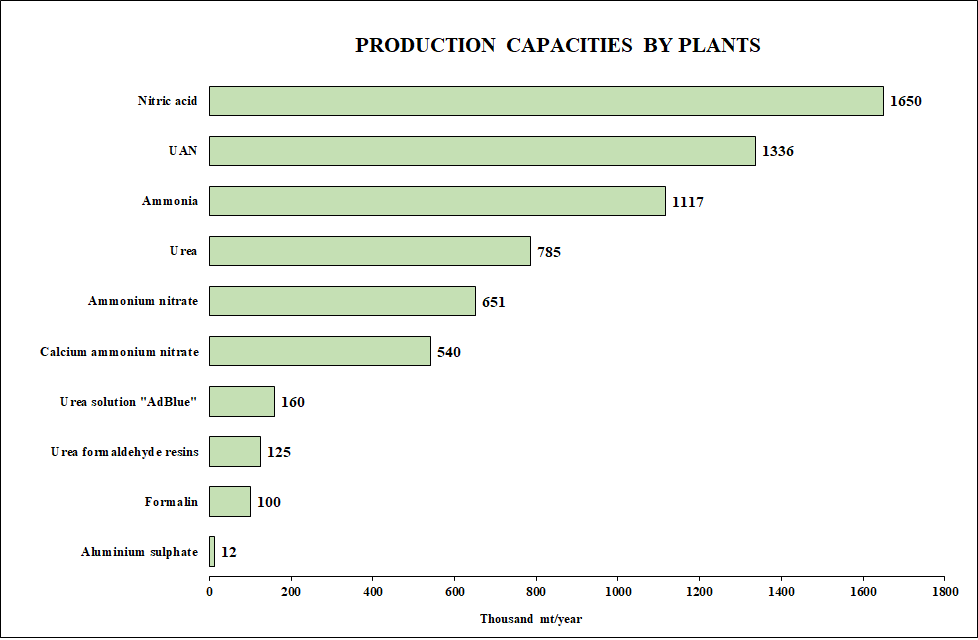
Nitric acid is a product mostly used as a composite part of other products. The subject matter of the production process consists of catalytic oxidation of gaseous ammonia with oxygen to produce nitrogen monoxide which in the course of further process turns to nitrogen dioxide after binding with oxygen. The final product is obtained after cooling the obtained nitrogen oxides and absorbing them with chemically treated water. Capacity – 1.650 thousand tons per year.
Liquid nitrogen fertilizers (UAN) means liquid fertilizers produced in certain proportion by mixing urea and ammonium nitrate solutions (melts) and diluting them with chemically treated water. The obtained mix is cooled. Capacity – 1.336 thousand tons per year.
Ammonia is the most important raw-material for the production of fertilizers. It is obtained from natural gas and air. Some of gas is incinerated to obtain heat and chemical reactions, the other share is purified and turned into liquid and gaseous ammonia via multi-level conversion. Capacity – 1.117 thousand tons per year.
Urea – granular, bulk fertilizers produced of liquid ammonia and carbon dioxide. Urea is also used as an ingredient in the production of other products. Capacity – 785 thousand tons per year.
Ammonium nitrate (AN) refers to granular bulk fertilizers received by neutralizing nitrogen acid with gaseous ammonia and by adding magnesium nitrate as a stabilizing additive to improve physical properties of the product. Capacity – 651 thousand tons per year.
Calcium ammonium nitrate (CAN) is a granular bulk fertilizer. CAN is produced by grinding dolomite and mixing with ammonia nitrate solution. The mix is granulated, dried, sieved, cooled, and conditioned. Capacity – 540 thousand tons per year.
“AdBlue” is a liquid additive used in the fuel of diesel engines the production of which is based on the dilution of urea solution with salt-free water. Capacity – 160 thousand tons per year.
Urea formaldehyde resins (UFR) and urea melamine formaldehyde resins (UMFR) are produced of formalin, melamine, and urea in two stages. At the first stage, the resins are obtained by polycondensation reaction method, whereas during the second stage, their concentration is increased by using vacuum evaporation. Capacity – 125 thousand tons per year.
Formalin is produced of a mix of air, water and methanol in contact apparatus where formaldehyde is produced under high temperature and catalyzers. It is later absorbed with water and results in the formation of formalin. This product is also used as an ingredient in the production of other products. Capacity – 100 thousand tons per year.
Basic aluminum sulphate solution – used as a coagulant in natural waters for industrial and human consumption, clarification, wastewater treatment, paper industry. The BAST-M modification uses a Fe2O3 additive that accelerates the above mentioned processes.
Investments
2003
2006
2007
2008
2009
2011
2012
2013
2014
2015
2016
2018
2021
Logistics
Chain of handling and logistics is one of the core advantages of Achema, and its gateway to global markets; secure, reliable and effective transport is an essential fertilizer trade component.
Achema exports major part of its production by rail, mostly to the ice-free Klaipeda seaport located 290 km west of the Company headquarters in Jonava. At the port products are loaded to cargo vessels and shipped to destination ports. An important role in this process is played by associated companies of Achema Group:
- Klasco, Klaipeda State Seaport:
- Loading services: dry cargo vessels and tankers up to 60 – 65 thousand tonnes;
- Maximum berth depth up to 13 metres;
- Liquid fertilizer storage capacity of 87 thousand tonnes;
- Bulk fertilizer storage capacity of 220 thousand tonnes;
- Packed fertilizer storage capacity of 15 thousand tonnes;
- Agro Baltic terminal, Lubeck, Germany: 30 thousand tonnes of liquid fertilizer storage capacity, annual liquid fertilizer reloading capacity of 150 thousand tonnes;
- Fertigent terminal, Gent, Belgium: 30 thousand tonnes of liquid fertilizer capacity; Convenient geographical location of Gent enables Achema products to reach North-eastern France and North-western Germany;
- Transachema: rail transport and expedition services (semi-wagons, hopers, tanks);
- Trasachema branch Euroga: cargo transport; cargo loading/reloading, storage; customs intermediary services; ship agency services;
- Achempak: polypropylene big-bags for fertilizer and other product packing, transport and storage;
- Krovinių terminalas: oil, chemical product and liquid fertilizer storage and loading services for panamax-type vessels; annual reloading capacity up to 2 million tonnes.